The Science of Spectral Needs for Enclosed Aquatic Ecosystems
Understanding aquatic spectral needs means looking beyond brightness and wattage to examine how different wavelengths of light interact with fish, aquatic plants, corals, algae, and the physical environment inside an aquarium. An enclosed aquatic ecosystem has limited opportunities to compensate for unsuitable lighting, so the spectrum, intensity, daily duration, and distribution of illumination all deserve careful attention.
The practical challenge is that no single light spectrum is ideal for every aquarium. A planted freshwater tank, a fish-only marine system, and a reef aquarium contain organisms with different biological requirements. Even two aquariums with similar inhabitants can respond differently because of water depth, dissolved organic matter, plant density, and existing nutrient conditions.
The most reliable approach combines biological evidence with gradual adjustments and observable outcomes. Instead of treating a lighting schedule as a universal recipe, aquarists can use spectral principles, suitable measuring tools, and an aquarium light controller to establish conditions appropriate for their particular ecosystem.
Key Takeaways: What Aquarium Light Actually Needs to Accomplish
Light performs several distinct functions in an aquatic environment. It enables photosynthesis in plants and photosynthetic microorganisms, influences the visual appearance of fish and corals, and helps establish daily patterns of activity and rest. These functions overlap, but they do not have identical lighting requirements.
- Match the spectrum to the organisms. Photosynthetic plants and corals require usable wavelengths, while fish-only systems generally prioritize appropriate daily illumination, natural coloration, and a consistent light-dark cycle.
- Evaluate intensity separately from spectrum. A light can provide useful wavelengths at an unsuitable intensity, or produce a visually bright appearance without delivering the desired amount of photosynthetically active radiation to submerged organisms.
- Account for the entire water column. Light reaching the aquarium surface is not necessarily the same as light available near the substrate, beneath floating leaves, or inside a coral colony.
- Change one important variable at a time. Simultaneously changing color channels, daily duration, fertilizer, and water circulation makes it difficult to identify the cause of an improvement or decline.
- Use automation for consistency, not guesswork. An aquarium light controller can repeat a carefully chosen schedule, but automation cannot determine whether that schedule is biologically appropriate without suitable observations and measurements.
The central principle is straightforward: establish the biological objective first, determine what the available evidence can tell you, and then adjust the lighting system to meet that objective without introducing unnecessary stress or instability.
How Light Spectrum Interacts With Aquatic Biology
Visible light is part of the electromagnetic spectrum, commonly described by wavelength in nanometers. Different wavelengths can interact differently with photosynthetic pigments, animal visual systems, and the water through which the light travels.
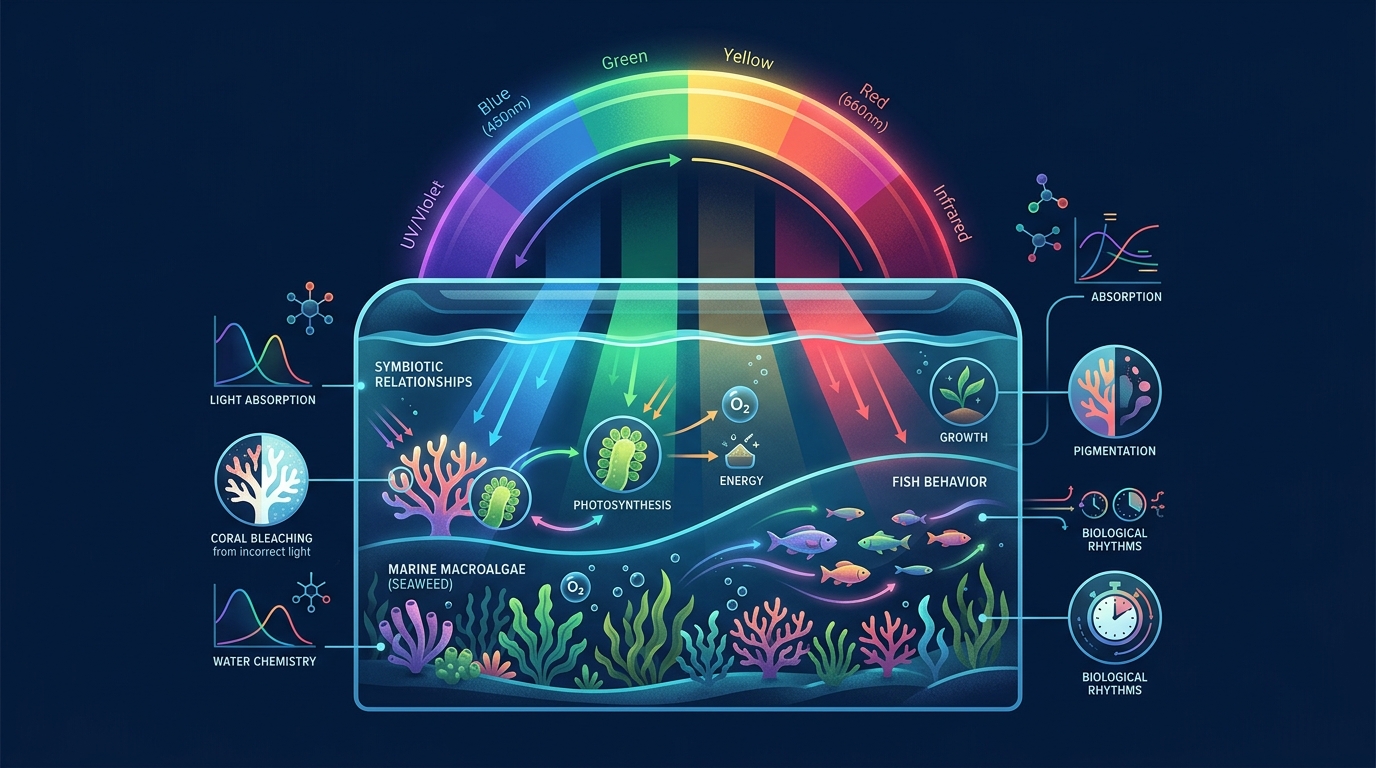
Blue light occupies the shorter-wavelength portion of the visible spectrum, green light lies in the middle, and red light occupies the longer-wavelength portion. These categories are useful for understanding lighting, but they should not be mistaken for three isolated biological switches. Real organisms respond to combinations of wavelengths, light intensity, exposure duration, and environmental conditions.
Photosynthesis depends on more than a single preferred color
Chlorophyll a and chlorophyll b absorb light in particular regions of the spectrum, including important blue and red bands. Other photosynthetic pigments can broaden the range of usable wavelengths. The resulting photosynthetic response depends on the organism's pigment composition, physiological condition, and the intensity of the light reaching its tissues.
For aquatic plants, this means that a fixture producing blue and red wavelengths can support photosynthesis, but a narrow two-color spectrum is not automatically superior to a broader white spectrum. Many aquarium plants grow successfully under balanced white lighting because it provides a mixture of wavelengths that supports their photosynthetic processes while allowing aquarists to observe plant health and fish coloration clearly.
Green wavelengths are also relevant. Although chlorophyll absorbs some green light less strongly than certain blue and red wavelengths, green light can penetrate farther into dense plant canopies than some strongly absorbed wavelengths. Its contribution should therefore not be dismissed simply because a plant appears green.
Photosynthetically active radiation provides a more useful measurement
Photosynthetically active radiation, or PAR, describes light within the conventional 400–700 nanometer band used to characterize photosynthesis. In aquarium practice, PAR meters commonly report photosynthetic photon flux density in micromoles of photons per square meter per second, written as µmol/m²/s.
PAR measurements are often more informative than electrical wattage or perceived brightness when assessing lighting for photosynthetic organisms. Wattage describes electrical power consumption, while lumens and lux emphasize the sensitivity of human vision. Neither directly tells an aquarist how many photosynthetically active photons reach a submerged plant or coral.
PAR is not a complete description of biological usefulness, however. Two fixtures can deliver similar PAR readings while producing different spectral distributions. Organisms may respond differently to those distributions, and some biologically relevant wavelengths fall outside the conventional PAR band.
For this reason, PAR should be interpreted alongside the fixture's spectral characteristics, the species being maintained, and the location of the measurement. A reading taken immediately below the water surface cannot automatically be applied to plants growing several inches deeper.
Blue, Green, Red, and Violet: What Each Region Can Tell You
Color-channel descriptions are helpful when comparing lighting modes, but their biological meaning depends on the complete system. The following table summarizes general principles rather than universal wavelength prescriptions.
These ranges are approximate and overlap. The boundaries do not represent sharp biological cutoffs, and a fixture's marketing labels do not substitute for measured spectral output.
A particularly important distinction concerns ultraviolet radiation. Ultraviolet wavelengths are generally below 400 nm, while visible violet light occupies the short-wavelength edge of human vision. Ultraviolet exposure can have biological effects, but adding UV output is not a universal route to healthier fish, more colorful corals, or better plant growth. The risks depend on wavelength, dose, exposure, and the organisms involved.
Freshwater Plants, Fish, and Corals Have Different Lighting Objectives
The appropriate spectrum begins with the life forms an aquarium is intended to support. A planted freshwater aquarium and a reef system may both use programmable LED lighting, yet their biological objectives can differ substantially.
Planted freshwater aquariums
Submerged plants need adequate light for photosynthesis, but the appropriate intensity varies with species, growth form, nutrient availability, and carbon supply. Slow-growing plants attached to wood or rocks often have different requirements from demanding carpeting plants or dense, rapidly growing stems.
For a low-light aquarium, a broad-spectrum white LED and a moderate, consistent schedule may be sufficient. Increasing intensity simply because plants appear slow can be counterproductive if carbon availability, nutrient balance, temperature, or plant acclimation is the real limiting factor.
Floating plants, tall stems, and dense hardscape create additional complications. A light level suitable for the upper leaves may not reach shaded lower leaves. If lower growth deteriorates while the upper canopy remains healthy, examine shading and light distribution before raising the entire fixture's output.
Fish-only aquariums
In a fish-only system without significant photosynthetic organisms, lighting generally serves visual observation, coloration, habitat presentation, and the establishment of a predictable daily rhythm. The spectrum need not be optimized for plant photosynthesis when no plants or photosynthetic animals depend on it.
Fish differ in their visual sensitivity, activity patterns, habitat associations, and tolerance of sudden changes. A strong blue-heavy display may appeal to the aquarist, but visual attractiveness to humans does not establish that the intensity or timing is suitable for the fish.
Provide an appropriate dark period, avoid abrupt transitions where practical, and assess behavior as well as appearance. Persistent hiding, repeated startled movements, or avoidance of illuminated areas may justify reducing intensity or changing the transition schedule, although those behaviors can also indicate other environmental or health problems.
Reef aquariums and photosynthetic corals
Many reef-building corals host photosynthetic dinoflagellates that supply a substantial portion of their energy under suitable conditions. These symbiotic organisms contain photosynthetic pigments and accessory pigments that interact with the light environment. Other coral species and reef-associated organisms have different nutritional and illumination requirements.
Blue-rich lighting is common in reef aquariums because relevant wavelengths can support photosynthesis and produce familiar fluorescent visual effects. Nevertheless, a blue-heavy appearance alone does not prove that a coral receives an appropriate photon dose. The actual output, coral placement, acclimation history, water clarity, and species-specific response all matter.
Some corals tolerate relatively low light, while others can benefit from stronger illumination when other conditions are suitable. A universal reef PAR target is therefore misleading. Published ranges, experienced husbandry guidance, and measured conditions can inform a starting point, but they should be interpreted in relation to the species and the complete system.
When a coral is moved from a dimmer environment to a brighter one, gradual acclimation is generally safer than immediately applying the full intended output. If tissue recession, unusual paling, or persistent contraction develops after a lighting change, review the change and other water conditions rather than assuming that a stronger spectrum will solve the problem.
Water Depth and Optical Conditions Change the Spectrum That Arrives
An aquarium light does not operate in empty air. Water absorbs and scatters light, and suspended particles, dissolved substances, glass, surface movement, and aquarium decorations further affect how illumination reaches organisms.
In natural aquatic environments, longer red wavelengths are often attenuated more strongly with increasing depth than some blue wavelengths, although the exact pattern depends on water composition and clarity. This helps explain why underwater environments can appear progressively blue at depth. It does not mean that every aquarium should use the same blue-heavy setting.
Most home aquariums are relatively shallow compared with oceans and deep lakes. The fixture's beam angle, distance from the water, tank dimensions, and the geometry of the aquascape may therefore be as important as the broad spectral pattern.
For example, a narrow-beam fixture mounted high above a deep aquarium may create bright central regions and dim edges. A broad fixture mounted closer to the water may distribute light more evenly, but could also create surface glare or concentrate excessive light in shallow areas.
Water clarity also matters. Yellowing dissolved organic matter and suspended particles can change the amount and distribution of light reaching the bottom. Algal films on the glass can create localized shading, while floating plants can reduce illumination throughout the water column.
Practical decision rule: If organisms near the surface are healthy but those at the bottom are consistently struggling, first inspect shading, fixture coverage, water clarity, and local PAR. If the distribution is adequate but growth remains poor, investigate species requirements and non-light factors before changing the spectral balance.
Intensity, Photoperiod, and Spectrum Must Be Evaluated Together
Spectrum describes the distribution of wavelengths, intensity describes the amount of light arriving at a location, and photoperiod describes how long illumination lasts. These variables combine to determine the overall light exposure experienced by aquatic organisms.
A simplified daily light integral, or DLI, expresses the total number of photosynthetically active photons received per unit area over a day. It is commonly expressed in mol/m²/day. In a simplified situation with constant PAR, it can be estimated as:
DLI = PAR × illuminated seconds per day ÷ 1,000,000
For example, a constant PAR of 30 µmol/m²/s maintained for eight hours produces a theoretical DLI of 0.864 mol/m²/day. This calculation illustrates the relationship between intensity and duration; it is not a recommended target for any particular species.
Real programmable lighting often ramps up and down, so the daily total depends on the full intensity curve rather than the peak setting alone. A controller that gradually raises output for two hours and lowers it for another two hours produces a different daily photon exposure from one that holds peak intensity for the same overall clock period.
Extending a photoperiod is not equivalent to correcting every spectrum problem. If plants are already receiving excessive light, adding more hours can worsen the imbalance. Conversely, increasing intensity may be unnecessary when a plant's primary limitation is inadequate carbon supply.
The practical objective is a suitable and repeatable combination of spectrum, intensity, and duration. Each should be assessed in relation to the aquarium's organisms, growth goals, and observable response.
Using an Aquarium Light Controller as a Measurement and Consistency Tool
An aquarium light controller can coordinate daily schedules, channel intensities, gradual transitions, and repeated lighting patterns. Depending on the model and fixture, it may also support sunrise and sunset simulation, scheduled color changes, or integration with other aquarium automation systems.
Its primary benefit is control over timing and repeatability. A carefully configured schedule helps reduce accidental variations caused by inconsistent manual switching. It also allows an aquarist to document changes and compare biological responses under similar conditions.
However, a controller does not necessarily measure PAR, identify the fixture's true spectral output, or detect stress in fish and corals. Those capabilities require suitable sensors, independent measurements, or direct observation. A smartphone app displaying channel percentages is reporting settings, not necessarily the amount of light reaching the substrate.
Build a schedule around a defined biological objective
Begin by deciding what the lighting should accomplish. A fish-only aquarium may need a comfortable viewing period and a consistent day-night cycle. A planted tank may need enough usable light for its plant species without creating an imbalance between light, nutrients, and carbon. A reef tank may require carefully controlled conditions at multiple coral locations.
Next, establish a baseline schedule and document it. Record the main channel settings, the start and end of illumination, transition periods, and any available PAR measurements. If the fixture provides a spectral graph, retain it with the schedule because channel percentages alone may not reveal the complete output.
Change one major variable at a time whenever practical. If you increase overall intensity, avoid simultaneously extending the photoperiod and radically altering the spectrum. Otherwise, a positive or negative result will be difficult to interpret.
Where the controller supports it, gradual ramps can reduce abrupt changes in illumination. They should be treated as a method of managing transitions rather than a guarantee of improved health. The most important factors remain appropriate exposure, a suitable dark period, and the needs of the organisms being maintained.
When assessing equipment, distinguish a true aquarium light controller from a basic outlet timer. A timer can reliably switch a compatible fixture on and off, but it cannot independently adjust spectral channels unless the lighting system supports that functionality.
Warning Signs, Risks, and the Limits of Spectral Evidence
Light-related problems can be difficult to identify because many visible symptoms have multiple possible causes. Algae growth, pale leaves, coral bleaching, or fish hiding may coincide with a lighting change without being caused by spectrum alone.
Algae, for example, respond to light availability as well as nutrient conditions, organic matter, grazing pressure, and maintenance. Reducing the light may help in some situations, but it will not necessarily resolve the underlying imbalance. Similarly, pale plant leaves may reflect nutrient deficiency, and coral tissue changes may result from temperature stress, unstable water chemistry, disease, or other environmental factors.
Evidence also has limits. Laboratory studies may isolate a wavelength or measure a particular species under controlled conditions, while a home aquarium contains interacting organisms and changing environmental variables. A result observed in one plant species, coral species, or experimental setup should not automatically be generalized to every aquarium.
Manufacturer spectral graphs and PAR maps can be useful, but their interpretation depends on measurement conditions. Results taken at different mounting heights, output settings, water depths, or sensor positions are not directly interchangeable. Marketing claims about enhanced growth or coloration should be evaluated against clearly described measurement methods and biological outcomes.
Caution: Do not use spectrum adjustments as a substitute for diagnosing an unstable aquarium.
If fish are gasping, several animals become distressed, or a coral develops rapid tissue loss, assess urgent environmental problems such as temperature, dissolved oxygen, water chemistry, and equipment failure. If a sudden lighting change clearly preceded the problem, restore a previously tolerated setting when safe to do so, but do not delay investigation of other causes. Avoid introducing intense UV exposure or abrupt, high-intensity lighting changes as an improvised treatment.
Situation-specific action thresholds
Useful decisions depend on the severity, timing, and distribution of the symptoms rather than a single visual cue.
- If plant growth is slow but leaves remain healthy: verify the species' light requirements and check nutrients, carbon availability, and shading before increasing intensity.
- If algae increases after a lighting adjustment: review the new intensity and photoperiod, then examine nutrient inputs, maintenance, and organic waste. Consider a modest lighting reduction if exposure was increased beyond the system's needs.
- If lower plants deteriorate while upper leaves thrive: inspect canopy shading and measure light at lower positions before raising the entire fixture's output.
- If corals pale or retract after an increase in light: review the timing and size of the change, return to a previously tolerated exposure if appropriate, and assess water stability and other stressors.
- If fish repeatedly avoid the illuminated region: reduce abrupt exposure or excessive intensity where appropriate, provide suitable cover, and investigate other potential causes of abnormal behavior.
- If a light is visually bright but photosynthetic growth is poor: do not assume the solution is a higher wattage. Check actual light delivery, spectrum, species requirements, and environmental limitations.
These thresholds are troubleshooting guides, not diagnostic tests. A single pale leaf or a brief hiding episode does not establish a lighting problem. A persistent decline, a clear association with a lighting change, or several affected organisms warrants a more systematic investigation.
A Practical Self-Check Before Changing Aquarium Lighting
Use this checklist before making a substantial adjustment. The purpose is to identify whether a proposed change has a defensible biological objective and whether the aquarium is stable enough for a meaningful comparison.
- Identify the main organisms that depend on light, including demanding plants, photosynthetic corals, and any other relevant species.
- Confirm the fixture's available channels and obtain reliable spectral information when available.
- Record the current intensity settings, daily duration, and transition schedule.
- Check light distribution at the water surface, midwater, substrate, and important organism locations.
- Measure PAR where useful and feasible, using consistent sensor placement and measurement conditions.
- Inspect glass, floating plants, hardscape, and other sources of shading or uneven illumination.
- Review nutrient availability, carbon supply in planted tanks, water clarity, temperature, and water chemistry as appropriate.
- Photograph or record current growth and behavior so that future observations can be compared with a baseline.
- Change one major lighting variable at a time and retain a record of the previous schedule.
- Confirm that the aquarium light controller or timer can implement the intended settings reliably.
- Define what would count as improvement and which warning signs would prompt a return to the previous setting.
If several fundamental checks remain unresolved, postpone fine spectral tuning. A more complex lighting program cannot compensate reliably for uncertain species requirements, inadequate water quality, or an unstable aquarium environment.
How to Interpret Results Without Overreacting
Biological responses occur on different timescales. Fish behavior can change quickly, while plant growth patterns may take days or weeks to become apparent. Coral responses can vary with species, acclimation, and the severity of an environmental change. A single observation immediately after adjusting a controller rarely provides enough evidence to judge long-term success.
Establish a baseline before changing settings. Record plant growth, leaf condition, algae distribution, fish behavior, and coral appearance where relevant. Use photographs from consistent angles and lighting conditions to reduce the risk of confusing a change in visual appearance with a change in biological condition.
After a moderate adjustment, observe the system over an appropriate period for the organisms involved. This does not mean waiting through obvious distress. If severe symptoms appear, respond promptly and investigate. For ordinary growth comparisons, however, repeated observations are more useful than frequent daily changes to the schedule.
When an intervention produces no clear benefit, reconsider the original hypothesis. If stronger light fails to improve plant growth, the limiting factor may be carbon, nutrients, or species suitability. If reducing light has little effect on persistent algae, the main problem may lie elsewhere. The correct response is not always another spectral adjustment.
This approach also reveals when precision is unnecessary. A stable fish-only aquarium with modest lighting needs may not benefit meaningfully from a costly multichannel system. In contrast, a complex planted aquarium or reef system may benefit from the repeatability and flexibility of programmable lighting, especially when those capabilities support measured and documented decisions.
Frequently Asked Questions About Aquatic Spectral Needs
1. Is blue light always best for aquatic organisms?
No. Blue wavelengths can contribute to photosynthesis and influence biological responses, but their value depends on the organism, intensity, exposure duration, and accompanying wavelengths. Many freshwater plants grow well under broad-spectrum white lighting, while fish-only systems may have no reason to prioritize photosynthetic performance.
2. Can red light alone grow aquarium plants?
Some red wavelengths can support photosynthesis, but red-only lighting is not a universal solution. Plant responses depend on pigment composition, intensity, developmental conditions, and other environmental factors. A broader spectrum is often a practical starting point for mixed planted aquariums because it supports useful illumination while providing a natural-looking view of the tank.
3. Does a higher-wattage aquarium light provide better growth?
Not necessarily. Wattage indicates electrical power consumption, not the amount of useful light reaching a particular plant or coral. Fixture efficiency, spectral output, beam distribution, mounting height, and water depth all influence the delivered exposure. A suitable PAR measurement is generally more informative for evaluating photosynthetic light availability.
4. How many hours should aquarium lights stay on?
There is no single ideal duration for every aquarium. The appropriate photoperiod depends on the organisms, light intensity, natural environmental cues, and system stability. Establish a consistent schedule suited to the aquarium, then adjust it cautiously if observations indicate a problem. More hours do not automatically produce healthier plants or corals.
5. Can an aquarium light controller prevent algae?
No. A controller can make lighting schedules consistent and help reduce excessive exposure, but algae growth also depends on nutrients, organic matter, maintenance, and biological competition. Automation is most useful when it supports a balanced husbandry plan rather than serving as a substitute for identifying the cause of an algae problem.
6. Do reef corals require ultraviolet lighting?
Not as a universal husbandry rule. Some lighting systems include violet or ultraviolet output, but these are not interchangeable categories. The need for any particular wavelength depends on the species and conditions. Unnecessary UV exposure can introduce risks, so it should not be added simply because a fixture advertises it as a coral-enhancement feature.
7. Should the entire aquarium use one uniform intensity?
Not necessarily. Different plants and corals occupy different positions and may require different light exposures. Hardscape, depth, and shading naturally create variation. If the aquarium contains organisms with substantially different needs, consider placement and measured local conditions rather than forcing every region to match a single target.
8. How often should the spectrum be changed?
There is no universal adjustment interval. Once a suitable schedule is established, consistency usually makes evaluation easier. Change settings when there is a clear reason, such as a documented mismatch between light delivery and biological requirements, a change in livestock, or evidence of excessive exposure. Avoid repeatedly changing channels in response to every minor variation in appearance.
9. Can a smartphone measure aquarium PAR accurately?
A smartphone's ordinary light sensor is not a substitute for a suitable PAR meter. Phone sensors are generally designed for other purposes, and their spectral response and calibration may not match the requirements of underwater photosynthetic measurements. A dedicated, appropriately calibrated instrument provides more defensible results when precise comparisons are important.
Conclusion: Build the Spectrum Around the Ecosystem
Understanding aquatic spectral needs requires more than selecting a preferred color or copying a lighting schedule from another aquarium. Spectrum, intensity, photoperiod, water depth, species biology, and overall environmental stability interact to determine the conditions experienced by fish, plants, and corals.
The strongest practical method is to begin with the organisms' known requirements, establish a stable baseline, measure light delivery when useful, and adjust settings in a controlled way. PAR can clarify how much photosynthetically active light reaches a location, while spectral information helps explain which wavelengths contribute to that exposure. Neither measurement alone provides a complete prediction of biological health.
An aquarium light controller adds value by making schedules repeatable, managing transitions, and preserving a record of changes. Its usefulness depends on the quality of the underlying decisions. A sophisticated program cannot correct an unsuitable spectrum by itself, overcome every nutrient limitation, or identify the cause of animal distress without additional evidence.
When results are uncertain, investigate the simplest plausible explanations first. Check distribution and shading before increasing output, review the complete light-dark cycle before extending exposure, and examine water conditions when symptoms cannot be explained by lighting alone. Respond promptly to serious warning signs, but avoid treating every minor change as proof of spectral failure.
Ultimately, effective aquarium lighting is not the pursuit of a universally perfect spectrum. It is the disciplined process of matching available light to the needs of a particular enclosed ecosystem, recognizing the limits of measurements, and making only those adjustments that the evidence and the organisms' responses can reasonably support.


Comments
Post a Comment