What Critical Aquarium Changes Smart Monitors Detect Before You Ever See Them
Smart aquarium monitoring is most valuable at the moment when an aquarium still looks normal. Clear water, active fish, and apparently healthy plants do not prove that the underlying chemistry is stable. Temperature can drift, dissolved oxygen can fall during the night, pH can move with photosynthesis, and nitrogen compounds can change as the biological filter responds to waste. These changes may become measurable before they become visually obvious.
That timing is the central reason to monitor an aquarium ecosystem instead of relying only on appearance. A sensor does not predict every disease or tell an aquarist exactly what intervention to make. What it can do is make otherwise hidden changes visible sooner, especially when it records repeated measurements rather than producing a single number. Aquaculture guidance identifies temperature, pH, dissolved oxygen, ammonia, salinity and related characteristics as important components of water-quality assessment, while research shows that exposure effects can develop before dramatic visible symptoms appear.
Start With This Five-Minute Self-Check
Before interpreting a smart aquarium monitor, begin with the simplest question: What changed, and when? The following checklist is designed to prevent a common monitoring mistake—seeing an unusual number and immediately treating the number rather than investigating the cause.
- Check temperature trend: Is the current temperature different from the normal daily pattern, or is it simply a routine day-night variation?
- Check dissolved oxygen timing: Did the lowest reading occur overnight or near the beginning of the light period?
- Check pH direction: Is pH gradually moving, oscillating each day, or showing an abrupt step?
- Check ammonia and nitrite: Are nitrogen compounds changing after feeding, maintenance, stocking changes, or filter disruption?
- Check the sensor itself: Is the probe clean, correctly positioned, calibrated as required, and still behaving consistently?
- Check context: Did anything else change—feeding, water replacement, aeration, lighting, medication, filter flow, room temperature, or equipment operation?
- Check the animals: Are there behavioral changes even though the water still appears clear?
Why Clear Water Is Such a Weak Warning System
Human observation is excellent for noticing obvious problems: cloudy water, an unusual odor, damaged plants, dead organisms, surface gasping, or a sudden change in swimming behavior. It is much less effective at detecting a chemical or physical change that has not yet altered the aquarium's appearance.
Dissolved oxygen is a straightforward example. Oxygen is consumed by fish, microorganisms, plants, and decomposition processes. It can also be affected by temperature, circulation, surface exchange, photosynthesis, and aeration. FAO material describes dissolved oxygen as a major water-quality parameter and notes that oxygen can fluctuate through the day. In pond systems, concentrations may be lowest around dawn after the nighttime period without photosynthetic oxygen production. That principle is useful in closed aquariums too, even though the exact pattern depends on the tank's stocking, plants, circulation, lighting, and aeration.
Dissolved oxygen can change while the water still looks completely clear. A monitor that samples repeatedly can expose a nighttime trough that a visual inspection at noon would never reveal. This is an important distinction: continuous measurement does not necessarily tell an aquarist that a problem is occurring; it can reveal when a potential problem occurs, which is often the missing piece of the investigation.
Temperature Is More Than a Comfort Number
Temperature is easy to think of as a static setting: choose the appropriate range for the species and keep it there. In reality, temperature interacts with biological activity and water chemistry. FAO guidance notes that temperature affects chemical and biological processes and influences oxygen availability. Modern experimental work has also shown that temperature can affect the accumulation and transformation of nitrogen compounds in closed aquatic systems.
This means a temperature monitor can provide early information even when the temperature itself does not look alarming. Imagine a tank that normally stays stable but begins warming several degrees during a hot room-temperature episode. The immediate visual appearance may be unchanged. Yet the altered temperature can change oxygen conditions and the pace of biological processes. In a closed system, that can change the trajectory of other parameters.
Temperature can change how quickly a nitrogen problem develops. That does not mean every temperature rise creates an ammonia event. It means temperature belongs in the same diagnostic timeline as ammonia, nitrite, dissolved oxygen, and pH rather than being treated as an unrelated number.
The table is deliberately diagnostic rather than prescriptive. There is no universal aquarium number that can be applied safely to every species, salinity, life stage, stocking density, and system design. The useful question is often whether the reading is consistent with that aquarium's established pattern and the biological requirements of its inhabitants.
pH Can Turn a Simple Reading Into a Context Problem
pH is particularly important because it is not isolated from other measurements. It can move over a normal daily cycle in planted systems as photosynthesis and respiration change. It can also shift because of water replacement, buffering capacity, biological activity, or other changes in the aquarium environment.
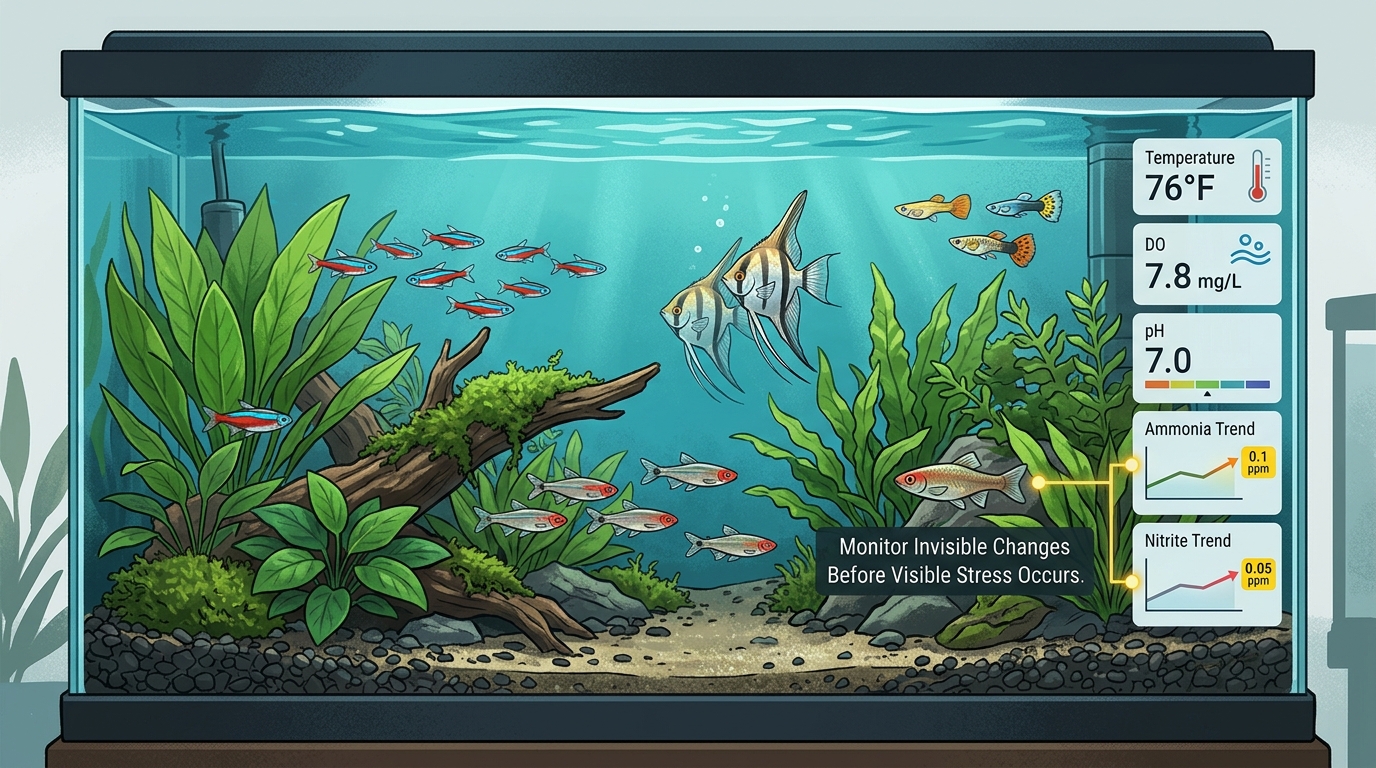
The relationship between pH, temperature, and ammonia is especially important. Total ammonia in water exists in more than one chemical form, and the balance between those forms changes with environmental conditions. FAO fish-health material specifically describes the importance of considering temperature and pH when evaluating the toxic, un-ionized fraction of ammonia.
pH and temperature change the meaning of an ammonia reading. This is why an aquarium monitor that reports multiple related parameters can be more informative than a device that produces an isolated ammonia number. The purpose is not to create a complicated dashboard. It is to prevent an overly simple interpretation of one measurement.
For example, if ammonia appears elevated, the next question should not automatically be, “What product should I add?” A more useful sequence is: confirm the reading, note pH and temperature, examine the recent feeding and maintenance history, inspect filtration and circulation, and consider whether the biological system has recently changed. The appropriate response depends on the species and the measured conditions.
Ammonia and Nitrite Can Move Before the Fish Look Different
Nitrogen waste is one of the clearest examples of why early measurement matters. Fish produce nitrogenous waste, while uneaten food and decomposing organic matter can add to the nitrogen load. In an established biological filter, microbial processes transform nitrogen compounds through stages. When that biological system is disturbed, the expected progression can change.
Ammonia and nitrite deserve special attention when the biological system is changing. The reason is not that every detectable reading is automatically dangerous. The relevant interpretation depends on the species, concentration, duration, pH, temperature, salinity, oxygen conditions, and other factors.
Peer-reviewed research illustrates why duration matters. A 2024 study of Nile tilapia found measurable physiological changes during prolonged exposure to comparatively low concentrations of unionized ammonia, even though that result cannot be directly converted into a universal aquarium threshold for other species. Other research has demonstrated interactions between elevated pH and ammonia toxicity. These studies reinforce a useful monitoring principle: a fish can experience a meaningful water-quality stressor before a dramatic visible symptom.
This is exactly where trend data can help. A single ammonia measurement tells you what was measured at one point. A sequence can show whether ammonia is stable, climbing, falling, or repeatedly rising after a particular event. The second type of information is often more useful for finding the cause.
The Most Valuable Signal May Be the Trend, Not the Number
Smart monitoring is sometimes described as if its main benefit were a warning alarm. Alarms are useful, but trend detection can be more informative because aquarium changes rarely occur in a vacuum.
A trend is often more informative than an isolated number. Suppose the temperature rises every afternoon, pH follows a predictable daily curve, and dissolved oxygen falls overnight before recovering after the lights come on. That pattern tells a different story from a sudden one-time jump in temperature or a pH value that changes sharply at an unusual hour.
The same reasoning applies to nitrogen compounds. If ammonia rises repeatedly after unusually heavy feeding, the timing provides a clue. If nitrite rises after a filter has been disturbed, that timing matters. If a sensor reports a dramatic change but a manual check and the aquarium's recent history disagree, the sensor itself becomes part of the investigation.
Monitoring therefore works best as a timeline:
- Record the parameter.
- Record the time.
- Record relevant environmental events.
- Compare the new value with the aquarium's established pattern.
- Verify surprising readings before making a major change.
- Look for relationships between parameters rather than treating each number independently.
What Smart Monitors Can Detect Before Your Eyes Can
A useful way to understand a smart aquarium monitor is to divide changes into four categories: slow drift, repeated cycles, sudden events, and relationships between measurements.
Slow drift
A slow temperature or pH drift can be difficult to notice because each individual change is small. A recorded history makes the direction visible. This is particularly useful when the aquarium looks normal but its baseline is gradually moving.
Repeated cycles
Daily cycles can be nearly invisible to casual observation. Dissolved oxygen, pH, temperature, and other parameters can show patterns connected to lighting, room conditions, photosynthesis, respiration, circulation, and feeding. A monitor can make those recurring changes visible as a graph rather than forcing the aquarist to remember yesterday's readings.
Sudden events
A heater malfunction, aeration interruption, circulation failure, unusual room-temperature change, or accidental equipment shutdown can create a parameter change that occurs faster than someone checks the aquarium. A sensor can register the event even when nobody is watching.
Relationships
The most useful insight can come from two or more parameters moving together. A temperature change accompanied by an oxygen change means something different from a temperature change with no corresponding shift. A pH movement occurring at the same time each day suggests a different investigation than an abrupt pH step after maintenance.
Wrong Choices: What Monitoring Should Not Make You Do
More data does not automatically mean better aquarium care. A monitoring system can create new mistakes if every unusual reading is treated as an emergency.
Several common mistakes follow from misunderstanding what monitoring can do:
- Treating an alarm as a diagnosis. An alarm identifies a condition that deserves attention; it does not identify its cause.
- Ignoring the sensor. A dirty, poorly positioned, damaged, or incorrectly calibrated probe can create misleading confidence.
- Chasing every small fluctuation. Natural variation is not necessarily a failure of the aquarium.
- Using a universal threshold without context. Fish species and life stages differ, and water chemistry is interactive.
- Looking only at the current value. A normal value can hide an abnormal trend, while an unusual value can be harmless if it represents a known short-lived cycle.
How to Improve the Monitoring Process in the Right Order
The order of operations matters more than the number of sensors. A practical monitoring workflow can be built from the following sequence.
1. Establish the aquarium's normal baseline
Collect enough observations to understand ordinary daily behavior. Record time, temperature, pH, and any other parameters relevant to the system. If dissolved oxygen is being measured, pay particular attention to the timing of low points.
2. Identify the parameters that can change fastest
Not every parameter needs identical attention. In many aquatic systems, dissolved oxygen and pH can vary substantially over a day, while some other changes develop more slowly. FAO material notes that transient water-chemistry components can require routine attention in higher-density systems.
3. Connect measurements to events
When a parameter changes, ask what happened immediately before it. Feeding, filter maintenance, water replacement, equipment changes, unusual heat, lighting changes, livestock additions, or medication can all become useful timeline markers.
4. Verify unexpected readings
If a sensor suddenly reports an implausible change, compare it with a second measurement method when available. Inspect the probe and its placement. If the sensor is wrong, treating the tank based on the false reading can create a second problem.
5. Act according to urgency, not anxiety
If fish are in obvious distress or an essential life-support component has failed, immediate action may be appropriate. If the aquarium looks normal and the monitor shows a modest departure from baseline, investigation and confirmation may be more appropriate than a drastic correction.
If the reading is both unexpected and independently confirmed, investigate the aquarium. If the reading is unexpected but cannot be confirmed, investigate the measurement process first. If the reading is expected and repeats on a stable daily cycle, document the pattern before deciding that it is a problem.
Where Smart Monitoring Has Real Limits
Smart monitoring is not a substitute for observing fish, maintaining equipment, or understanding the biology of the aquarium. A sensor measures what its sensing method can measure. It does not automatically detect every contaminant, pathogen, mechanical failure, or biological condition.
There is also a trade-off between continuous measurement and measurement complexity. A system with many sensors can produce more information but also more opportunities for calibration problems, fouling, poor placement, conflicting readings, and alert fatigue. For a lightly stocked aquarium with stable conditions and attentive maintenance, a simpler measurement routine may be sufficient. A densely stocked or highly automated system has more reason to benefit from continuous trend data.
Another limitation is species specificity. A published concentration associated with effects in one fish species should not be converted into a universal “safe” or “danger” line for every aquarium inhabitant. Even research findings that are scientifically useful may have been generated under controlled experimental conditions that differ from a home aquarium.
In other words, the monitor is best understood as an instrument for improving awareness, not an automatic caretaker.
FAQ: What Smart Aquarium Monitoring Can and Cannot Tell You
Can a smart monitor detect a problem before fish show symptoms?
It can detect measurable changes before those changes become visually obvious. For example, a decline in dissolved oxygen or a developing ammonia trend may be measurable while the water still looks clear and fish behavior appears normal. That does not mean every measurable change will eventually cause visible illness or harm.
Which aquarium parameters are most useful to monitor?
The answer depends on the aquarium. Temperature, dissolved oxygen, pH, ammonia, nitrite, nitrate, salinity, and other parameters can be relevant in different systems. The most useful set is the one that reflects the biological needs of the inhabitants and the known failure modes of that particular aquarium.
Why does a monitor need to track pH alongside ammonia?
Because pH and temperature influence the balance between chemical forms of ammonia. A total-ammonia reading therefore needs context. Monitoring related parameters together can make an unusual reading easier to interpret.
Can clear water still have dangerous chemistry?
Yes. Water appearance is not a direct measurement of dissolved oxygen, ammonia, nitrite, pH, or temperature. Clear water can coexist with an invisible chemical or physical change.
Is one reading enough to prove something is wrong?
Usually, no. A single reading can be important, particularly when animals are visibly distressed, but an unexpected sensor value should normally be interpreted with its timing, recent aquarium events, sensor condition, and corroborating measurements in mind.
Why are trends useful if the monitor already gives an alarm?
An alarm identifies a departure from a defined condition. A trend can help explain the departure. Knowing whether a parameter changed gradually, abruptly, only at night, after feeding, or after maintenance can narrow the possible causes.
Can a smart monitor replace manual water testing?
Not universally. Sensor capabilities differ, and some parameters are still better verified with another measurement method. Manual testing can also serve as a cross-check when a sensor reading conflicts with the aquarium's history or expected behavior.
Who benefits most from continuous monitoring?
Continuous monitoring is particularly useful when a system has meaningful periods of unattended operation, substantial stocking, automation, sensitive inhabitants, or known parameter swings. It may provide less incremental value in a simple, stable aquarium that is already checked consistently and has few rapidly changing risks.
The Practical Information-Synthesis: See the Aquarium as a Timeline
The strongest lesson from water-quality science is not that every aquarium needs more technology. It is that important changes can occur before the human eye has an obvious signal. Temperature, dissolved oxygen, pH, ammonia, and nitrite do not all move at the same speed, and they do not act independently.
That makes the most useful monitoring question more specific than “Is the water good?” Ask instead: What is changing, how fast is it changing, what else changed at the same time, and is the measurement independently credible?
When a monitor shows a new pattern, the first improvement is better observation. If dissolved oxygen falls only overnight, investigate the nighttime system. If pH moves with the light cycle, interpret the pattern in relation to photosynthesis and respiration. If ammonia rises after a biological disruption, examine the nitrogen-processing system and recent waste load. If a sensor produces an isolated value that conflicts with every other observation, verify the sensor before changing the aquarium.
The real advantage of smart aquarium monitoring is therefore not a futuristic screen full of numbers. It is the ability to make invisible changes part of the aquarium's visible history. By combining trend data with direct observation, appropriate manual verification, and species-specific knowledge, an aquarist can investigate emerging changes while there is still time to understand what is happening rather than waiting for the tank to make the problem obvious.


Comments
Post a Comment